Creating a great podcast is only part of the growth equation.
You can have strong conversations, valuable insights, polished audio and a consistent publishing schedule, but if listeners cannot find your show, growth will always feel harder than it should.
That is where podcast SEO becomes important.
Podcast SEO is the process of improving your podcast’s visibility across podcast apps, search engines and discovery systems by making your show easier to understand, categorise and recommend. It includes your podcast title, show description, episode titles, episode descriptions, keywords, categories, transcripts, publishing consistency, platform distribution and overall content strategy.
In simple terms, podcast SEO helps answer three questions:
What is your podcast about?
Who is it for?
Why should it appear when someone searches for that topic?
When those answers are unclear, your podcast becomes harder to discover. When they are clear, consistent and strategically optimised, your show has a much stronger chance of being surfaced to the right listeners.
GrowMyPod is a podcast SEO platform that helps podcasters analyse their RSS feed, identify discoverability gaps and build a growth plan.
This guide explains how podcast SEO works, what to optimise, common mistakes to avoid and how to build a search-friendly podcast growth system.
What Is Podcast SEO?
Podcast SEO is the practice of optimising your podcast so that listeners, podcast platforms and search systems can better understand and discover your content.
It is similar to website SEO, but it has its own rules and signals.
Traditional website SEO often focuses on pages, backlinks, technical structure and search-engine rankings. Podcast SEO focuses more heavily on metadata, episode relevance, listening platforms, search terms, content themes and catalogue clarity.
Important podcast SEO elements include:
- podcast name
- show description
- episode titles
- episode descriptions
- categories
- keywords and topic relevance
- publishing consistency
- transcripts
- show notes
- platform availability
- episode artwork
- audience positioning
- content strategy
Podcast SEO is not about stuffing keywords into every title. It is about making your podcast clear, searchable and relevant.
A listener should be able to see your title and description and immediately understand what your show offers. A podcast app should be able to read your metadata and understand which topics your episodes relate to. A search engine should be able to connect your content to the questions people are already asking.
Why Podcast SEO Matters
Podcast discovery is becoming more competitive.
Millions of podcasts are available across Apple Podcasts, Spotify, YouTube, Amazon Music and other listening platforms. Many shows cover similar topics, compete for the same listeners and publish into crowded categories.
That means discoverability can no longer be left to chance.
A podcast may struggle to grow if:
- the title is vague
- the description lacks searchable context
- episode titles do not clearly explain the topic
- keywords are missing or inconsistent
- the show is listed on too few platforms
- the category is too broad or too competitive
- the episode catalogue lacks a clear content strategy
- old episodes are poorly optimised
- listeners cannot quickly understand the value of the show
Podcast SEO helps fix those issues.
It makes your podcast more discoverable by improving the signals that platforms and search systems use to understand your content. It also improves the human experience because clearer titles and descriptions help potential listeners decide whether an episode is worth their time.
Strong podcast SEO does not guarantee downloads, rankings or audience growth. But weak podcast SEO can create unnecessary friction that prevents your best content from being found.
How Podcast Search Works
Every podcast platform has its own discovery system. Apple Podcasts, Spotify, YouTube, Amazon Music and podcast directories do not all work in exactly the same way.
However, most systems rely on a combination of signals such as:
- podcast title
- episode title
- show description
- episode description
- creator name
- category
- keywords and topics
- listener behaviour
- freshness
- relevance
- popularity
- platform availability
- content consistency
Some platforms may also use transcripts, captions, user behaviour, recommendations, topic modelling and engagement patterns.
As a podcaster, you cannot control every ranking or recommendation signal. But you can control the quality and clarity of your metadata.
That is where podcast SEO begins.
Your job is to make your podcast easy to understand.
If your podcast is about small business marketing, say that clearly.
If an episode explains how to grow a podcast audience, make that clear in the title and description.
If your show helps independent podcasters improve discoverability, avoid vague language that hides the topic.
Search systems work best when content is specific. Listeners do too.
The Core Elements of Podcast SEO
1. Podcast Title
Your podcast title is one of the most important discoverability signals.
A strong title should be memorable, relevant and clear. It should help listeners understand what your show is about without needing to decode an inside joke, abstract phrase or overly clever brand name.
There are two common approaches.
The first is a direct descriptive title:
Example:
Podcast Growth Lab
The second is a brand-led title with a descriptive subtitle:
Example:
GrowMyPod: Podcast SEO, Analytics and Audience Growth
The second approach is often useful when the brand name alone does not explain the topic.
A title like “The Growth Room” might sound interesting, but it does not tell podcast platforms or listeners whether the show is about business, health, investing, podcasting, leadership or personal development.
A clearer title gives both humans and algorithms more context.
2. Podcast Description
Your podcast description is your show’s positioning statement.
It should explain:
- who the podcast is for
- what topics it covers
- what listeners will gain
- why the show is different
- what keywords naturally describe the content
A weak description might say:
“Conversations about creativity, growth and ideas.”
That sounds broad and forgettable.
A stronger description would say:
“Podcast Growth Lab helps independent podcasters improve discoverability, optimise episode titles, understand podcast analytics and build a content strategy that attracts more listeners.”
The second version gives search systems much more context. It also tells the right listener exactly why the show matters.
Your description should be written for humans first, but it should include the language your audience uses when searching.
3. Episode Titles
Episode titles are critical because every episode creates a new opportunity to be found.
Many podcasters make the mistake of using vague or overly creative episode titles that do not explain the content.
For example:
Weak title:
“Breaking Through”
Better title:
“How to Break Through a Podcast Growth Plateau”
The second title is more searchable, more specific and more useful to someone browsing a podcast app.
A strong episode title should:
- clearly describe the topic
- include relevant search language
- create curiosity without becoming clickbait
- avoid unnecessary filler
- place the most important topic early
- be understandable without reading the full description
Episode titles do not need to be boring. They need to be clear.
The best titles combine search relevance with listener appeal.
4. Episode Descriptions
Your episode description gives listeners and platforms additional context.
A strong episode description should include:
- a clear summary of the episode
- the main topics discussed
- who the episode is for
- key questions answered
- relevant keywords
- guest names, when applicable
- useful links
- a clear call to action
Avoid descriptions that are too short.
For example:
“In this episode, we talk about podcast growth.”
That tells listeners almost nothing.
A stronger version would be:
“In this episode, we explore why many podcasts stop growing after the first few months. You will learn how episode titles, podcast descriptions, platform distribution and content strategy affect discoverability, and how to identify the SEO gaps that may be limiting audience growth.”
This version is still natural, but it gives search systems and potential listeners more useful information.
5. Categories
Podcast categories help platforms understand where your show belongs.
Choosing the right category matters because it affects how your podcast is grouped and discovered.
A common mistake is choosing a category that is too broad or too competitive.
For example, a podcast about podcast marketing could choose “Business,” but that category is extremely broad. Depending on the platform options available, a more specific category may help the show appear in a more relevant competitive environment.
The best category is not always the biggest category. It is the category where your podcast is most relevant and has the clearest audience fit.
6. Keywords and Topic Alignment
Podcast SEO is not about adding random keywords. It is about aligning your podcast with the topics your audience genuinely cares about.
For example, a podcast for creators might cover:
- podcast growth
- podcast SEO
- audience growth
- podcast marketing
- episode titles
- content strategy
- podcast analytics
- podcast monetisation
- podcast distribution
Those terms should appear naturally across the show description, episode titles, descriptions and content themes.
The goal is consistency.
If your podcast is about podcast growth, but your titles and descriptions rarely use the language of podcast growth, search systems have less context to work with.
Keyword alignment helps your catalogue build topical authority over time.
7. Transcripts and Show Notes
Transcripts and show notes can support podcast discoverability beyond podcast apps.
A transcript turns spoken content into searchable text. This can help search engines understand the content of the episode and can also improve accessibility for listeners who prefer or need text.
Show notes can provide a structured summary of the episode, links, resources and key takeaways.
A good episode page might include:
- embedded audio
- episode title
- short summary
- detailed show notes
- transcript
- guest information
- resources mentioned
- related episodes
- newsletter signup
- call to action
If you publish episodes on your own website, each episode page can become a search asset.
8. Platform Distribution
Podcast SEO is not only about keywords. It is also about availability.
If your podcast is missing from major listening platforms, you reduce the number of places where potential listeners can discover your show.
Important platforms may include:
- Apple Podcasts
- Spotify
- YouTube
- Amazon Music
- Pocket Casts
- Castbox
- Goodpods
- Listen Notes
- Podcast Index
- Deezer
- iHeart
- TuneIn
The exact platforms that matter will depend on your audience and region.
A podcast distribution check can identify where your show is listed, where it is missing and whether your metadata appears consistently across platforms.
9. Publishing Consistency
Publishing consistency can support growth because it helps build listener habits.
A consistent schedule also gives your content strategy structure. Whether you publish weekly, fortnightly or in seasons, your audience should understand when to expect new episodes.
Inconsistent publishing does not automatically prevent discovery, but long gaps can make it harder to build momentum.
Consistency also helps with planning. When you know your publishing rhythm, you can build topic clusters, seasonal arcs and strategic episode sequences.
10. Content Strategy
Podcast SEO is not just about optimising what already exists. It is also about deciding what to publish next.
A strong podcast content strategy considers:
- what topics you have already covered
- which themes are underdeveloped
- what your audience is likely searching for
- which episodes support your show’s authority
- where there are gaps in your catalogue
- which topics are trending or gaining momentum
- how each episode fits into the broader journey
Random episode ideas can create a scattered catalogue.
Strategic episode planning helps build a stronger content arc.
For example, if you run a podcast about podcast growth, your catalogue might need a sequence such as:
- how podcast discovery works
- how to optimise podcast titles
- how to improve episode descriptions
- how to analyse podcast performance
- how to build a 90-day growth roadmap
- how to use audience data to plan future episodes
Each episode supports the next. Over time, the podcast becomes easier to understand and easier to recommend.
Common Podcast SEO Mistakes
Mistake 1: Vague Episode Titles
Titles like “Big Lessons,” “The Truth,” “Getting Started” or “What Comes Next” may sound interesting, but they do not provide enough context.
A better title tells the listener exactly what the episode covers.
Mistake 2: Short Descriptions
Many podcasts use descriptions that are only one or two sentences long. This wastes valuable metadata space.
A good description should summarise the episode, include key topics and explain the listener benefit.
Mistake 3: Ignoring Old Episodes
Your back catalogue can become a powerful discovery asset.
Older episodes may still be relevant, but they often have weak titles, thin descriptions or missing keywords. Updating them can improve clarity and make the catalogue more useful.
Mistake 4: Choosing Topics Without Search Intent
Not every episode needs to chase search volume. But if none of your episodes reflect what your audience is actively looking for, discoverability becomes harder.
Balance original ideas with searchable topics.
Mistake 5: Keyword Stuffing
Adding the same keyword repeatedly does not create good podcast SEO.
Search systems and listeners both need clarity, not repetition.
Use natural language. Make the topic obvious. Avoid awkward phrasing.
Mistake 6: Poor Platform Distribution
If your show is only available on one or two platforms, you are limiting discovery.
Make sure your podcast is available wherever your likely listeners already listen.
Mistake 7: No Clear Audience
A podcast that tries to speak to everyone often becomes hard to position.
The more clearly you define your audience, the easier it becomes to write titles, descriptions and episode topics that attract the right listeners.
How to Optimise a Podcast for SEO
Step 1: Audit Your Podcast Metadata
Start by reviewing your current podcast title, description, categories and episode catalogue.
Ask:
- Is the podcast topic immediately clear?
- Does the description explain who the show is for?
- Are important keywords missing?
- Are episode titles descriptive?
- Are episode descriptions detailed enough?
- Is the show listed across relevant platforms?
- Are older episodes still optimised?
This audit gives you a baseline.
Step 2: Improve Your Podcast Description
Rewrite your show description so it clearly communicates:
- the main topic
- the target listener
- the problems you solve
- the themes you cover
- the reason someone should listen
Avoid vague positioning. Make the value obvious.
Step 3: Optimise Episode Titles
Review your episode titles and identify the weakest ones.
Look for titles that are:
- too vague
- too clever
- missing the topic
- too long
- overloaded with episode numbers
- unclear without context
Rewrite them so the main topic is easy to understand.
For example:
Before:
“Getting Unstuck”
After:
“How to Get Your Podcast Growing Again After a Listener Plateau”
Step 4: Strengthen Episode Descriptions
For each important episode, improve the description by adding:
- a clear opening summary
- the main topics discussed
- the questions answered
- relevant search phrases
- guest names
- links or resources
- a call to action
The description should make the episode easier to understand before the listener presses play.
Step 5: Identify Keyword Gaps
Review the topics your podcast should be known for.
Then compare those topics against your existing catalogue.
For example, a podcast about podcast growth may discover it has episodes about interviews and motivation, but very little content about:
- podcast SEO
- episode title optimisation
- podcast analytics
- platform distribution
- content strategy
- audience retention
- podcast discovery
Those missing areas become future episode opportunities.
Step 6: Build Topic Clusters
A topic cluster is a group of related episodes that build authority around a subject.
Instead of publishing isolated episodes, create connected content.
Example cluster:
Podcast SEO
- What Is Podcast SEO?
- How to Optimise Podcast Episode Titles
- How to Write Better Podcast Descriptions
- How to Use Transcripts for Podcast Search
- How to Track Podcast Discoverability
- Common Podcast Metadata Mistakes
This approach helps listeners explore related content and helps search systems understand the depth of your catalogue.
Step 7: Check Platform Distribution
Make sure your podcast is available on the platforms your audience uses.
Check whether your show appears correctly, whether the artwork displays properly and whether your metadata is consistent.
Missing platforms can create lost discovery opportunities.
Step 8: Use Data to Decide What to Publish Next
SEO improves when content strategy improves.
Instead of guessing your next topic, use data to guide your decisions.
Consider:
- which topics are gaining interest
- which episodes have strong observable signals
- which content gaps exist in your catalogue
- which competitor topics you have not covered
- which search terms align with your audience
- which episodes naturally follow from your existing arc
This makes your content roadmap more intentional.
Podcast SEO Checklist
Use this checklist to assess your podcast:
- Podcast title clearly communicates the topic
- Show description explains audience, value and themes
- Important keywords appear naturally
- Categories match the show’s actual focus
- Episode titles are specific and searchable
- Episode descriptions provide useful context
- Older episodes are reviewed and updated
- Podcast is listed across major platforms
- Transcripts or show notes are available where possible
- New episodes are planned around audience needs
- Catalogue has clear themes and topic clusters
- Metadata is accurate and not misleading
- Calls to action are clear
- Branding is consistent across platforms
- Performance is reviewed regularly
How GrowMyPod Helps With Podcast SEO
GrowMyPod is built to help podcasters find and fix the discoverability gaps that limit growth.
Instead of manually reviewing every title, description, platform listing and episode, GrowMyPod analyses your podcast and gives you a clearer view of what needs attention.
GrowMyPod can help you:
- review your podcast health score
- identify metadata weaknesses
- check episode-level SEO performance
- find weak titles and descriptions
- uncover keyword gaps
- review platform distribution
- receive a prioritised growth roadmap
- identify what content to publish next
- turn recommendations into tasks
- track progress over time
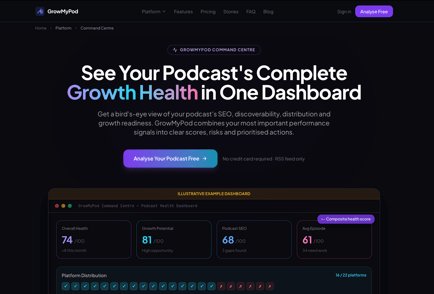
The Command Centre gives you a high-level view of your podcast’s overall growth health.
The Growth Playbook turns your scores into a prioritised action plan.
Podcast Content Strategy helps you decide what to publish next.
Episode Intelligence helps you optimise individual episodes for search, discovery and click appeal.
Together, these tools help move your podcast from guesswork to a structured growth system.
Podcast SEO Is a Long-Term Growth Strategy
Podcast SEO is not a one-time task.
It is an ongoing process of improving how your podcast is understood, discovered and experienced.
The best results come from consistent optimisation:
- clearer titles
- stronger descriptions
- better topic planning
- wider platform availability
- improved metadata
- smarter episode recommendations
- regular catalogue reviews
You do not need to fix everything at once.
Start with the highest-impact issues. Improve the episodes most likely to benefit from optimisation. Make your show description clearer. Check your platform distribution. Build a stronger content roadmap.
Small improvements across your catalogue can compound over time.
Final Thoughts
Your podcast may already have valuable content. The problem may be that platforms and potential listeners do not have enough clear signals to understand it.
Podcast SEO helps close that gap.
It makes your show easier to find, easier to evaluate and easier to recommend. It helps your content reach people who are already searching for the topics you cover.
If you want to grow your podcast, do not rely only on publishing more episodes.
Make the episodes you already have easier to discover.
Analyse your metadata. Improve your titles. Strengthen your descriptions. Expand your platform presence. Plan future content around real audience intent.
That is how podcast SEO becomes more than optimisation.
It becomes a growth system.
Ready to see what is limiting your podcast growth? Analyse your RSS Feed with GrowMyPod and get a personalised roadmap for improving podcast SEO, discoverability and audience growth.



Comments